

‘We have to help countries improve their readiness for future pandemics.’
World Bank Group President David Malpass called on the world to move urgently toward opportunities and solutions that achieve a green, resilient, and inclusive recovery from the COVID-19 pandemic in a speech today that advances the World Bank-IMF Spring Meetings.
“Our collective responses to poverty, climate change, and inequality will be the defining choices of our age.”
Mr. Malpass delivered the speech virtually at the London School of Economics; it was followed by a discussion with students, moderated by Baroness Minouche Shafik, Director of the London School of Economics.

 infestation in 70 years. They ate crops and threatened the food security of 3 million people. Locusts brought similar devastation to some of the poorest countries in Africa, the Middle East, and South Asia, as governments and communities braced for the COVID-19 pandemic.
 populations have been hardest hit. This crisis – more so than other crises before – requires scalable solutions for the world’s poorest. For many countries, this presents unchartered territory.
 in extreme poverty? When data are turned into valuable information, they have the potential to improve lives, transform economies, and help end poverty. Now more than ever, the world is facing new demands for data as our principal weapon in the war against COVID-19. The latest edition of the World Development Report from the World Bank provides a blueprint on how to harness the power of data for development, to ensure no one is left behind.
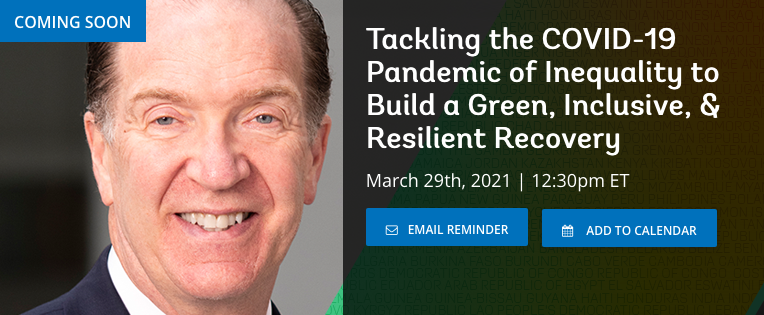 School of Economics as he discusses what is needed to build a green, inclusive, and resilient recovery from the pandemic. The crisis has worsened inequality and disproportionately impacted the poorest and most vulnerable, particularly women and children.
 Netherlands for the World Bank
You must be logged in to post a comment.