
 Deadline: 21-Mar-2018 at 11:59:59 PM (Eastern Time – Washington D.C.)
Objective: The IFCs FIG aims to reduce the agribusiness finance gap in emerging markets and achieve large-scale food-supply impact in Sierra Leone and Senegal, by providing financial institutions (FIs) with Investment and Advisory Services. FIG would like to hire a consulting firm to carry out a mapping exercise of the agricultural sector and some pre-selected crop value chains, aligned to the agricultural development policy and/ or strategy of the country. This will include a detailed analysis of the value chain actors and facilitators, the role and impact of FIs (banks, micro-finance institutions, savings and credit co-operatives) and an assessment of the existing and potential financial services delivery channels, especially agency banking and DFS, with respect to rural smallholder farmers.
Continue reading


 With more than 1.1 billion individuals without official proof of identity, a myriad of technologies is advancing at a faster speed than ever before and becoming more affordable, making it possible for nations to leapfrog paper based approaches of the past. Yet, it is becoming a challenge to understand and keep up with the various technologies and advancements that are especially relevant for digital identification systems.
 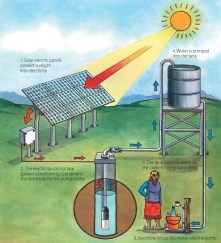 Access to a safe, sustainable water supply is a growing concern in every region of the world. In many communities, groundwater is being pumped by diesel fueled systems, which are both expensive and can be difficult to maintain. In communities where electricity is scarce, solar can be a part of the solution.
 Picture an island in Bangladesh that is so remote that there is no way the traditional electricity could reach it. Not now, and probably not anytime soon. That was the situation in Monpura just a few years ago – but not today.
 Deadline: 22-Mar-2018 at 11:59:59 PM (Eastern Time – Washington D.C.)
 My nephew Reuben was born on December 9, 2017. Reuben is a member of generation Alpha, a cohort that is younger than smartphones, cryptocurrency, and synthetic human cells. Reuben was born in Australia only a few short months after Sophia became the first robot citizen of Saudi Arabia. Reuben will take his first steps in a pair of self-tying shoes to walk into a world of self-driving (
 Creating more and better jobs is central to our work at the World Bank and a shared goal for virtually all countries —developed and developing alike. But oftentimes the policy debate turns to the cost and effectiveness of programs and projects in creating jobs.

You must be logged in to post a comment.