

Global value chains (GVCs) powered the surge of international trade after 1990 and now account for almost half of all trade. This shift enabled an unprecedented economic convergence: poor countries grew rapidly and began to catch up with richer countries. Since the 2008 global financial crisis, however, the growth of trade has been sluggish and the expansion of GVCs has stalled. Meanwhile, serious threats have emerged to the model of trade-led growth. New technologies could draw production closer to the consumer and reduce the demand for labor. And conflicts among large countries could lead to a retrenchment or a segmentation of GVCs. The World Development Report (WDR) 2020: Trading for Development in the Age of Global Value Chains examines whether there is still a path to development through GVCs and trade. It concludes that technological… change is at this stage more a boon than a curse. GVCs can continue to boost growth, create better jobs, and reduce poverty provided that developing countries implement deeper reforms to promote GVC participation, industrial countries pursue open, predictable policies, and all countries revive multilateral cooperation.
Tag Archives: Wereldbank Groep
World Bank Live
If you can’t be at the Meetings in person, we’ve got you covered with World Bank Live, the World Bank’s digital platform for live-streaming and engaging with global audiences. Block out time now to watch our events live, and in case you miss it, you can still catch up with your favorite events on our events recap page or watch a replay. Don’t forget to tune in to our Global Voices interviews with top-notch global development influencers, as well as our short 30-second challenge videos with experts sharing their knowledge on all things global development.

Building strong, inclusive economies and achieving successful country outcomes together at the 2019 Annual Meeting
Nearly 1.1 billion people escaped extreme poverty between 1990 and 2015, thanks to  broad-based economic growth and inclusive approaches to development. But progress is stalling, and we face an urgent challenge; today, one in 10 people still live in extreme poverty.
To boost action and accelerate progress towards tackling development challenges and reducing extreme poverty, delegates from our member countries, observer organizations, civil society, private sector, and media will convene at the 2019 Annual Meetings of the World Bank Group and the International Monetary Fund (IMF).
This year’s events will take place in Washington, D.C. from October 14-20, 2019.
International Debt Statistics 2020: External Debt Stock of Low- and Middle-Income Countries Rose, but Pace of Increase Slowed
External debt stock of low- and middle-income countries rose 5.2% in 2018 to $7.8  trillion, a slower pace of accumulation than in 2017, according to the World Bank’s International Debt Statistics 2020. Excluding the top ten borrowers (Argentina, Brazil, China, India, Indonesia, Mexico, Russia, South Africa, Thailand, Turkey) external debt stocks for low- and middle-income countries rose 4%.
Net debt inflows (gross disbursements minus principal payments) to low- and middle-income countries fell 28% in 2018 to $529 billion. At the same time, net financial flows (including both debt and equity) to low- and middle-income countries fell 19% in 2018, down 29% excluding China.
eC2: IFC Grainpulse Uganda Smallholder Farmer Baseline Data Collection
Deadline: 19-Oct-2019 at 11:59:59 PM (Eastern Time – Washington D.C.) 
IFC is seeking to hire a Firm to collect baseline data from smallholder farmers for this specific project. To estimate the impact of the IFC Grainpulse project interventions on smallholder farmers, a farmer panel survey will be conducted, collecting baseline and endline data. The objectives of this baseline survey are to: a) Create a profile of smallholder farmers, their household characteristics, including poverty and food consumption estimates as well as nutrition related indicators; farming practices; access to and utilization of agricultural inputs and services; access to finance; yields; sales; gender roles; and others. b) Establish a baseline for farmer livelihood and farming related indicators before the start of project implementation.Scope of work
Please note that the information noted here only refers to the baseline data collection for this project and that the Firm will be responsible for the implementation of all data collection activities linked to this initial survey round.
The World Bank Group Exceeds 2020 Climate Targets for the Second Year in a Row: Here’s How It Was Done
STORY HIGHLIGHTS 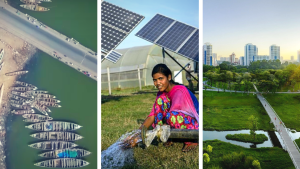
- In fiscal year 2019, the World Bank Group committed nearly $17.8 billion to climate-related investments, surpassing current targets for the second year in a row.
- Three country snapshots illustrate some of the ways climate change considerations were integrated in the project design: building climate resiliency into transportation systems in Sierra Leone; improving irrigation to address food security in Pakistan; and mitigating flood risk in Vietnam’s urban infrastructure.
- Going forward, the World Bank Group will invest and mobilize $200 billion in climate-related financing from 2021-2025, doubling what we did in the last five years and significantly ramping up support for adaptation.
eC2: TA Activity to establish a city-owned Yangon Flood Resilience Strategy
Deadline: 21-Oct-2019 at 11:59:59 PM (Eastern Time – Washington D.C.) 
The assignment described in this REoI, falls under the Technical Assistance activity attached to Component 2 of the Myanmar SEA-DRM project and is referred to as Yangon Flood Resilience Strategy. The consulting services (the Services) for Yangon Flood Resilience Strategy include: Task 1: Prepare three strategic directions that inform the formulation of a preferred Flood Resilience Strategy and prepare a Catalog of Measures, a matrix of design principles and example measures applicable to the Yangon situation,
Task 2: Establish a city-owned Flood Resilience Strategy for Yangon and engage with YCDC and Yangon Regional Government in a Multi-Criteria Analysis CBA to design a multi-annual Investment Program for flood resilience interventions (structural and non-structural) (Program of Measures) Task 3: Pre-feasibility Study (engineering design) for selected priority investment options.
eC2: Assessment on Electricity for Host Communities and Forcibly Displaced People in the Sahel
Deadline: 01-Jun-2020 at 11:59:59 PM (Eastern Time – Washington D.C.)
The overall objective of this activity is to conduct an assessment of electricity access to better understand demand and supply and identify market barriers, key market players and support required to promote the growth of basic electricity services for conflict-affected zones (borders), host communities and FDPs in the Sahel (Burkina Faso, Mali, Mauritania, Niger, Tchad).
Time to ACT! Realizing Indonesia’s urban potential
Indonesia has been transformed by urbanization. As a new World Bank report titled  Time to ACT: Realizing Indonesia’s Urban Potential shows, when its independence was proclaimed in 1945, only one in eight Indonesians lived in towns and cities, and the country’s entire urban population stood at about 8.6 million, roughly that of London today. By contrast, today about 151 million, or 56% of Indonesians live in urban areas, roughly 18 times the population of London.
eC2: Digital Economy For South Asia (DE4SA)- Digital Economy Assessments
Deadline: 15-Oct-2019 at 11:59:59 PM (Eastern Time – Washington D.C.) 
The World Bank Digital Development Global Practice (DD GP) is engaging with countries across Asia to identify new opportunities for growth and inclusion from the digital economy. These engagements have resulted in most cases from ongoing policy dialogue or investment lending programs and they reflect an interest from these countries to identify the public policies and investments that can promote their national digital economies. At the same time, there are opportunities to be realized through regional programs that could improve connectivity, access to markets, and grow the regional digital economy. In addition, there are also ongoing engagements with countries across Africa in other engagements.


You must be logged in to post a comment.