
Synopsis

- Social protection and labor programs help households and workers manage crises, escape poverty, navigate transitions, and seize employment opportunities.
- Despite recent progress, three in four people in the poorest countries have no social protection coverage. Across low- and middle-income countries, 2 billion people remain inadequately covered.
- The World Bank is committed to scaling up social protection programs, working with governments and partners, to reach 500 million more people by 2030.
Summary
Today, more people have access to social protection than at any point in history. Over the last decade, 4.7 billion people across low- and middle-income countries gained access to social protection. However, critical gaps remain. Two billion people in those countries remain uncovered or inadequately covered by social protection.
The State of Social Protection Report 2025: The 2-Billion-Person Challenge documents advances and challenges to strengthening social protection and labor systems across low- and middle-income countries and discusses avenues to gradually close the coverage and adequacy gap for the world’s poorest.
What is social protection?
Social protection is the set of public measures that protect individuals and families against economic and social distress, with the aim of ensuring a minimum level of wellbeing for all. The three pillars of social protection—social assistance, social insurance, and labor market programs—support households and workers in handling crises, escaping poverty, facing transitions, and seizing employment opportunities. Well-designed social protection programs have a high return on investment, support long-term human capital and economic growth, and help people become more self-reliant. For every dollar transferred to poor families, there is an estimated multiplier effect of $2.50 in the local economy.
Examples of social protection programs include: safety nets and cash transfers, pensions, skills development.
Social protection programs have expanded to 4.7 billion people
Social protection and labor programs support more people than ever. Over the past decade, low- and middle-income countries have expanded social protection to cover a record number of 4.7 billion people, a historic high. Coverage has increased by 10 percentage points – from 41% to 51% of the population between 2010 and 2022, with significant gains among the poor in low income countries.
Expansion of social protection 2010-2022:
Coverage more than doubled in low income countries but remains low

During the COVID-19 pandemic, emergency social protection responses reached 1.7 billion people in developing countries, demonstrating the importance of shock-responsive systems. Countries with robust delivery infrastructure prior to the pandemic responded more effectively, emphasizing the need for proactive investment.
Coverage gaps remain substantial across the world
Today, 2 billion people in low- and middle-income countries remain uncovered or inadequately covered by social protection, including over 1 billion people in Africa and South Asia alone.
2 billion people in low- and middle-income countries remain uncovered or inadequately covered:

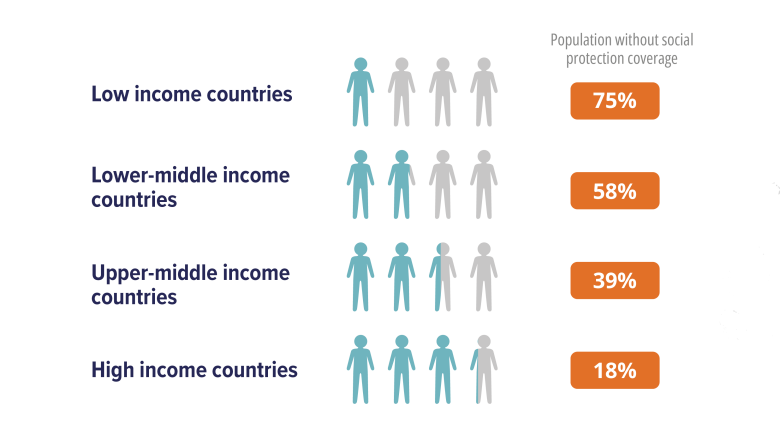
Three out of four people in low-income countries receive no form of social protection, and even in lower-middle-income countries, more than half of the population remains uncovered.
Social protection is at its lowest where it is needed most: among the poorest households in poorer countries:
Closing gaps in social services will take years
At current growth rates, it will take 18 years to achieve full coverage for those living in extreme poverty and 20 years to cover the poorest 20% of households in low- and middle-income countries.
Adequacy of benefits is uneven
For about 400 million people social protection benefits are so meager that they may not help recipients escape poverty or cushion the blow of unexpected shocks. In low income countries, social assistance transfers represent just 11% of the income of poor households.
Today, gender disparities persist with women receiving 81 cents for every $1 received by men on social protection benefits, on average, across a sample of 27 countries.
Unreached populations are disproportionately concentrated in fragile, conflict-affected, and hunger-prone regions of Africa, South Asia, and the Middle East.
Investing in employment programs is key
Social services and labor programs – such as public works, unemployment insurance, and job placement services – can greatly improve job opportunities and incomes for the poor. They can help the poor become more productive and prepare them with the right skills. Their impact, however, is often limited by low funding and designs that don’t account for local circumstances. Currently, spending on labor market programs is only 0.25% of GDP on average.
Policy recommendations
To accelerate progress, governments can take three policy actions, tailored to each country’s context, capacity, and fiscal restraints:
- Expand coverage by investing limited resources, particularly in low-income countries, in infrastructure such as databases, digital payments, and case management systems to effectively support those in need.
- Tailor support to help people, especially in middle-income countries, move beyond survival toward self-reliance.
- Build shock-responsive systems by strengthening data, payments, and early warning tools to provide timely support and employment stability during crises.
To help fund these recommendations, the report notes that using existing resources more efficiently could make a big difference. For instance, redirecting cash transfers to benefit the poor could supply nearly half of the funding required to cover the bottom 20 percent of the population with social protection.
The World Bank is committed to scaling up social protection programs, working with governments and partners, to reach 500 million more people, half of them women, by 2030.
 government and invests it in her small doughnut business. “I buy baking flour and make doughnuts for selling,” says Marcelina, a widow, who uses the money she makes to support her late sister’s five children. “From my last bi-monthly payment of 300 Kwacha ($14), I made doughnuts and sold them for 400 Kwacha that helps me pay for school fees for the orphaned children I look after. I urge all other widows to not only eat the money but grow it like I do.”
 abruptly halted the movement of people that characterizes our interconnected world. The implications are enormous for migrants, who rely on working away from home to support themselves, their families, and their communities. Many of them are now in conditions that put them at greater risk of contracting COVID-19. The pandemic is also affecting critical sectors like agriculture where labor shortages are looming.
 notable figures as John F. Kennedy and Yo-Yo Ma, Paulo Coelho and Rihanna. Their maxims on life hold true for markets.
  feed her children. Though she worked long hours buying and selling seafood from the local fisherman in her village, until recently, it wasn’t enough. “I couldn’t afford to cook every day,” she recalls.

 start-up. Your daughter lands a job as a freelance journalist. Your street vendor who sells flowers down the street has been absent due to an illness.
 Netherlands for the World Bank
You must be logged in to post a comment.