
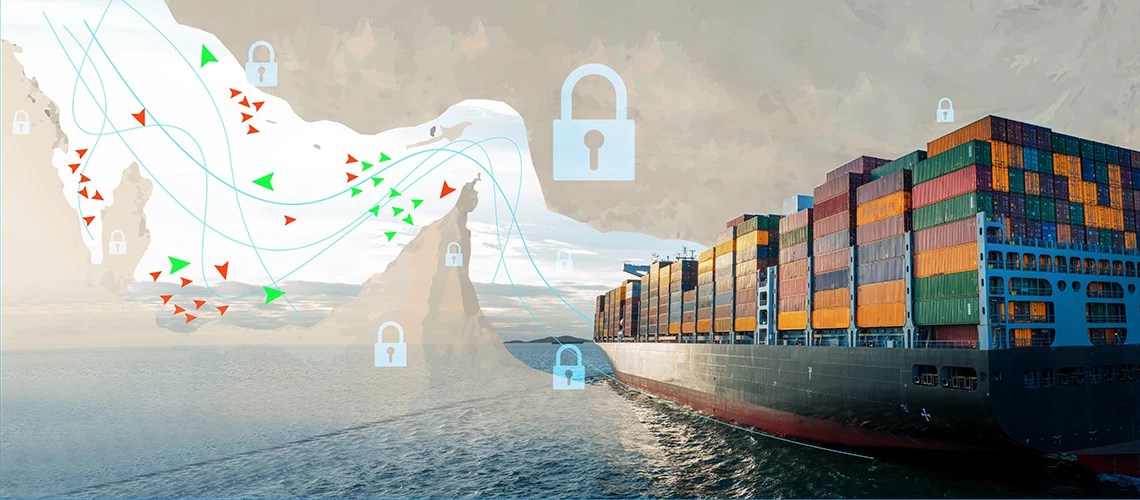
In just two months, a historic energy supply shock has upended commodity markets. The outlook for commodity prices and the global economy now depends largely on two factors: the extent of damage to production capacity in the Middle East and the speed and scale of the return of shipping through the Strait of Hormuz. Against this backdrop, this blog addresses five questions about the war’s economic implications.
1. How large is the commodity shock from the Middle East war?
The war has caused unprecedented commodity supply disruptions. Before the conflict, vessels transiting the Strait of Hormuz accounted for nearly 35 percent of global seaborne crude oil trade, 20 percent of refined petroleum product trade, and about 20 percent of liquefied natural gas trade (figure 1.A). The shutdown of shipping has triggered the largest energy supply shock on record, with 10 million barrels per day of oil supply lost in March (figure 1.B). The Gulf region is also a major source of fertilizers, aluminum, and many industrial inputs.
2. What is the outlook for energy prices?
Since March, prices of key commodities have surged. The price of Brent oil rose from $72 per barrel ($/bbl) at the end of February to $118/bbl at the end of March, the largest monthly increase on record (figure 2.A). Oil prices have since remained volatile, exceeding $126/bbl intraday in late April.
Annual average energy prices are projected to rise by 24 percent this year overall, with Brent oil averaging $86/bbl, up from $69/bbl in 2025. This forecast assumes the most acute disruptions will end in May, that exports through the Strait of Hormuz will return to near prewar levels by October, and that damage to energy production capacity will remain limited.
European natural gas prices are forecast to jump 25 percent, with Asian liquefied natural gas (LNG) and coal prices also rising sharply. Relative to expectations in January, the projections represent a shock of almost 40 percent to energy prices this year (figure 2.B).
Figure 2. Energy market impacts
3. What could happen to energy prices if disruptions persist?
Energy production and trade disruptions could prove more extensive and persistent than assumed in the baseline. Renewed conflict could delay a sustained reopening of the Strait of Hormuz beyond mid-2026. Shipping constraints could then slow the resumption of exports through late 2026 or early 2027. Under such circumstances, Brent oil prices could average $95 to $115/bbl in 2026 (figure 3.A).
Oil supply buffers and alternatives will be critical to stabilize markets. Strategic reserve releases, sanctioned oil in transit, alternative Gulf export routes, and biofuels could partly offset a shutdown for several months (figure 3.B). Residual flows through the Strait would also reduce the supply gap, but ongoing disruptions will erode stocks rapidly, as seen in recent weeks. Constraints on alternative pipeline substitution in the Middle East represent a major risk.
Figure 3. Risks of more extensive disruptions
4. How will the war-related disruptions affect other commodities?
The Middle East is a major fertilizer exporter, meaning trade disruptions are squeezing fertilizer supplies. War-related supply reductions for LNG and fertilizer feedstocks are also raising fertilizer production costs. Average fertilizer prices are projected to jump by more than 30 percent in 2026, driven by a 60 percent leap in urea prices.
Even so, food commodity prices are expected to rise only 2 percent this year, reflecting ample global grain production. Soaring fertilizer prices will therefore worsen fertilizer affordability for farmers, as happened in 2022 (figure 4.A). The food price forecast depends on conflict-related disruptions easing soon. If greater disruptions drive fertilizer and other input costs even higher, knock-on impacts on food prices could push tens of millions more people into acute food insecurity globally.
Base metals prices are also set to rise sharply this year, by 19 percent, as demand from emerging sectors adds to traditional uses. In addition, the war is raising input costs for metals mining and refining worldwide. Precious metals prices continue to set records, with average prices forecast to climb 42 percent in 2026, boosted by geopolitical uncertainty. Gold and silver prices are projected to be nearly four times their 2015–19 averages (figure 4.B).
Figure 4. Fertilizer and metals market impacts
5. What will higher commodity prices mean for inflation and economic growth?
The war is weakening economic growth prospects around the world. Emerging market and developing economies (EMDEs) are projected to grow 3.6 percent in 2026—a 0.4 percentage point downgrade since January (figure 5.A). EMDE commodity exporters are expected to grow just 2.4 percent, a 0.9 percentage point downward revision, mainly reflecting setbacks to economies directly impacted by hostilities. Growth in EMDE commodity importers has been revised lower by 0.2 percentage point, to 4.2 percent, with downgrades in 70 percent of these economies.
Amid a large energy price shock, higher inflation is accompanying weaker growth. Consumer price inflation in EMDEs, previously forecast at 4.1 percent in 2026, is now projected to rise to 5.1 percent in the baseline (figure 5.B). If more extensive disruptions push average Brent oil prices to $115/bbl this year, EMDE inflation could reach 5.8 percent—the highest rate since 2013, aside from 2022.
Figure 5. Growth and inflation impacts in emerging market and developing economies (EMDEs)
A. Growth forecasts for EMDEs, commodity exporters, and commodity importers
January 2026
Percent
Policy responses
As many governments have limited fiscal space, domestic policy responses should be timely, temporary, targeted, and funded within existing plans. International institutions can also assist countries to navigate the disruptions, working with domestic policy makers and the private sector to bring together information-sharing, policy expertise, technical innovation, and financial assistance.
The World Bank Group is supporting EMDEs through a three-part plan combining immediate assistance with longer-term development. First, it is helping countries access liquidity quickly through contingent financing, existing project balances, and fast-disbursing instruments. This can protect vulnerable households, meet urgent fiscal needs, support firms, and reduce financial sector risks. Second, if necessary, the institution will reprioritize pipeline resources toward the crisis response. Third, if crisis conditions persist, it will scale up the response through new financing, guarantees, and private sector support.
Ultimately, this historic shock is likely to reshape energy strategies. Energy importers are likely to strengthen energy security by expanding domestic production and accelerating the deployment of increasingly cost-competitive renewables. Commodity exporters could step up investment to bypass vulnerable bottlenecks. The result may be a lasting reordering of commodity trade, production, and policy priorities.
“Credit: World Bank Group. All rights reserved”
 don’t tell the full story of their impact.
  The COVID crisis heightened the need for multilateralism to tackle global challenges.
  developments of these markets is critical to the design of policy frameworks that facilitate the economic objectives of sustainable growth, inflation stability, poverty reduction, food security, and the mitigation of climate change. This study is the first comprehensive analysis examining market and policy developments for all commodity groups, including energy, metals, and agriculture, over the past century. It finds that, while the quantity of commodities consumed has risen enormously, driven by population and income growth, the relative importance of commodities has shifted over time, as technological innovation created new uses for some materials and facilitated substitution among commodities. The study also shows that commodity markets are heterogeneous in terms of their drivers, price behavior, and macroeconomic impact on emerging markets and developing economies, and that the relationship between economic growth and commodity demand varies widely across countries, depending on their stage of economic development. Policy frameworks that enable countercyclical macroeconomic responses have become increasingly common—and beneficial. Other policy tools have had mixed outcomes.


You must be logged in to post a comment.