
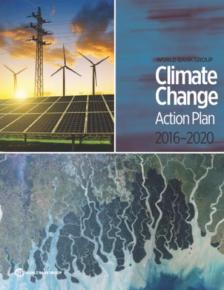
 Climate change poses an enormous challenge to development. By 2050, the world will have to feed 9 billion people, extend housing and services to 2 billion new urban residents, and provide universal access to affordable energy, and do so while bringing down global greenhouse gas emissions to a level that make a sustainable future possible. At the same time, floods, droughts, sea-level rise, threats to water and food security and the frequency of natural disasters will intensify, threatening to push 100 million more people into poverty in the next 15 years alone.
Category Archives: WBG News & Reports
Climate-related projects 2017 of the Worldbank
In FY2017, the WBG provided over $12 billion in financing for climate-related projects. Some results from our work include:
Cities:
- In Vietnam, the World Bank has assisted the city of Can Tho to become more climate resilient and promote sustainable urbanization and transport corridors. An investment of US$ 250 million from the Bank and US$ 10 million from the Swiss Development Agency (SECO) is implemented across six development sectors to increase the city’s physical, financial and social resilience to adverse events. One of the activities involves combining a transport link and an embankment, which has multiple benefits including reducing water displacement and flooding in the Mekong Delta.

Insights: How Do Policymakers Learn and Adapt Today?
Deadline: 26-Nov-2017 at 11:59:59 PM (Eastern Time – Washington D.C.)
Objective: The goal of this work is to re-assess and update CGAPs understanding of how policymakers in low capacity and low income countries take in information and knowledge that helps them perform and adapt. This work would help CGAP and its partners re-affirm and/or update our assumptions about how regulators, supervisors and other policy-makers build their capacity and how organizations supporting capacity building can or should reach this audience. The task would be to undertake a well-constructed perspective gathering exercise through needs analysis of a carefully selected group of policymakers representing different regional, hierarchical and demographic profiles that reflect well CGAPs and its partners target audience(s) in Latin America, Sub-Saharan Africa, Middle East, South Asia and East Asia. This perspective gathering conducted through desk research, surveys, interviews and the like would be further complemented by insights collected from a range of partners and other stakeholders.
15 Years of Reforms to Improve Business Climate Worldwide
WHAT IS “DOING BUSINESS”?
Doing Business is a project that provides objective measures of business regulations and their enforcement across 190 economies. It looks at domestic small and medium-size companies and measures the regulations applying to them through their life cycle.
By gathering and analyzing comprehensive quantitative data to compare business regulation environments across economies and over time, Doing Business encourages economies to compete towards more efficient regulation; offers measurable benchmarks for reform; and serves as a resource for policymakers, academics, journalists, private sector researchers and others interested in the business climate of each economy.

Why sustainable mobility matters
In the 1960s, the vision of future mobility was people with jet packs and flying cars – we believed these innovations wouldn’t be far off after the moon landing in 1969. Obviously, the reality in 2017 is somewhat different.
Today, we have congestion in cities, rural areas cut off from the rest of the world, and too many people without access to safe, efficient, and green transport. This stifles markets and hinders people from the jobs that will help them escape poverty. Without access to sustainable mobility, it will be much harder—if not impossible— to end poverty and achieve the Sustainable Development Goals (SDGs).

Doing Business Report 2018
Doing Business 2018: Reforming to Create Jobs, a World Bank Group flagship publication, is the 15th in a series of annual reports measuring the regulations that enhance business activity and those that constrain it. Doing Business presents quantitative indicators on business regulations and the protection of property rights that can be compared across 190 economies—from Afghanistan to Zimbabwe—and over time.
Doing Business measures regulations affecting 11 areas of the life of a business. Ten of these areas are included in this year’s ranking on the ease of doing business: starting a business, dealing with construction permits, getting electricity, registering property, getting credit, protecting minority investors, paying taxes, trading across borders, enforcing contracts and resolving insolvency. Doing Business also measures labor market regulation, which is not included in this year’s ranking.
Data in Doing Business 2018 are current as of June 1, 2017. The indicators are used to analyze economic outcomes and identify what reforms of business regulation have worked, where and why.
Commodity prices likely to rise further in 2018: World Bank
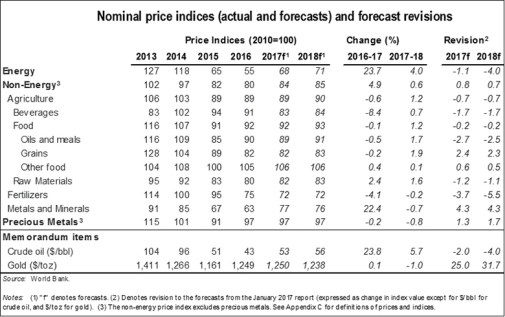 Oil prices to average $56 a barrel in 2018, up from 2017 average of $53/bbl
WASHINGTON, October 26 – Oil prices are forecast to rise to $56 a barrel in 2018 from $53 this year as a result of steadily growing demand, agreed production cuts among oil exporters and stabilizing U.S. shale oil production, while the surge in metals prices is expected to level off next year, the World Bank said on Thursday.
A Call to Act and Invest for the Future
Global growth has strengthened over the past year, with a recovery in investment, trade, and commodity prices amid supportive global financial conditions. Still, downside risks remain, and prospects for growth vary widely across countries. The World Bank Group is uniquely positioned to help developing countries address the complex challenges that can threaten their gains in an increasingly interconnected global economy.
This was a key message from the Development Committee, a ministerial-level forum of the World Bank Group and the International Monetary Fund, in a communiqué issued at the close of the institutions’ Annual Meetings in Washington.

World Bank Urges Action to Break the Cycle of Poverty from Generation to Generation
WASHINGTON, October 17, 2017 — The social status of one’s parents is as influential today as it was 50 years ago in determining a person’s future, according to early findings from an upcoming World Bank report, Fair Progress? Educational Mobility Around the World. Marking the 25th anniversary of the International Day to Eradicate Poverty, the institution sounded the alarm on a lack of progress since the 1960s in an area that is crucial for reducing poverty and inequality and promoting growth.
Data for Development: An Evaluation of World Bank Support for Data and Statistical Capacity
 Data and evidence are the foundation of development policy and effective program implementation, and countries need data to formulate policy and evaluate progress.
At the global level, the World Bank has a strong reputation in development data and has been highly effective in data production. It produces influential, widely used data and cross-country indicators that fill important niches, benchmark countries, and stimulate research and policy action.
 Netherlands for the World Bank
You must be logged in to post a comment.