
Juan and his family fled their home during Peru’s 1995 insurgency. Like many other 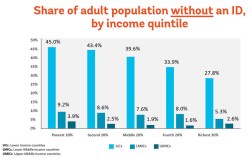 Peruvians, they left behind all of their possessions, including their IDs and other documents. Without an ID, Juan—along with 3 million other Peruvians whose civil registration records were lost or destroyed during this period—was unable to enroll in school or access basic social services.
Mariam, a cross border trader from Uganda, struggled to earn a livelihood because of the difficulty she faced in crossing the border to buy and sell goods in Kenya. Without the necessary IDs, she could not pass through regular border crossings and was forced to travel long distances in dangerous areas that left her vulnerable to theft and exploitation.
 million people (1 in 5) in Sub-Saharan Africa (SSA) who are critically undernourished. And the numbers are growing. Escalating weather volatility due to climate change further exacerbate food and nutrition insecurity. Frequent droughts and floods are triggering a food crisis in at least one or more countries every year, demanding emergency responses.
 economy to unleash ultrafast internet. The result has been beneficial to Malaysians, especially within the confines of a market with low adoption of fiber internet services in the past decade, compared to its regional peers. But now things are changing. The country’s broadband market is rapidly moving to become more accessible, with increased competition and better quality services – which could potentially expand the digital economy to provide the benefits of economic growth, job creation and social inclusion.
 decline. However, looking at global averages is not enough to understand this trend, as this decline has not been evenly distributed. We break down the world population into two groups (measured through either income or consumption expenditure): the bottom 40% (the poorest people in any given country) and the upper 60% of the income distribution.
 relationship between international connectivity and economic activity.
 feed her children. Though she worked long hours buying and selling seafood from the local fisherman in her village, until recently, it wasn’t enough. “I couldn’t afford to cook every day,” she recalls.
 profound impact on the workforce.
  need to adapt a central bank’s governance structure to its changing purpose, writing that “‘putting new wine into old bottles’ is safe only when you watch the condition of the bottle, and adapt its structure most carefully.” This metaphor is particularly useful in understanding new and emerging challenges involved in tailoring the structure of financial policy governance in the post-crisis era.
 Netherlands for the World Bank
You must be logged in to post a comment.