
Tag Archives: World Bank Group
Building Green: Sustainable Construction in Emerging Markets
At a Glance 
Switching to greener technologies in construction and operation of buildings and materials, combined with more climate-friendly capital markets, could reduce the construction value chain’s carbon footprint 23 percent by 2035, while creating investment opportunities in emerging markets, according to a major report from the International Finance Corporation.
WBG Procurement Opportunities
Interested in Doing Business with the World Bank Group? Please see selected opportunities below.
Procurement Framework and Regulations for Projects After July 1, 2016 (worldbank.org)
Publication: Commodity Markets Outlook, October 2023: Under the Shadow of Geopolitical Risks
Abstract
The conflict in the Middle East—the latest of an extraordinary series of shocks in recent years—has heightened geopolitical risks for commodity markets, in an already uncertain global environment. Before the conflict began, voluntary oil supply withdrawals by OPEC+ producers pushed energy prices up 9 percent in the third quarter. As a result, the World Bank’s commodity price index rose 5 percent over that period and is now 45 percent above its 2015-19 average. For now, the war’s impact on commodity prices have been muted. Prices of oil and gold have risen moderately, but most other commodity prices have remained relatively stable. Nevertheless, history suggests that an escalation of the conflict represents a major risk that could lead to surging prices of oil and other commodities. A Special Focus section provides a preliminary assessment of the potential impact of the conflict on commodity prices. It finds that the effects of the conflict are likely to be limited, assuming the conflict does not widen. Under that assumption, the baseline forecast calls for commodity prices to decline slightly over the next two years. If the conflict does escalate, the assessment also includes what might happen under three risk scenarios, relying upon historical precedents to estimate the effects of small, moderate, and large disruptions to the global oil supply. The magnitude of the effects will depend on the duration and scale of the supply disruptions.
WBG Procurement Opportunities
Interested in Doing Business with the World Bank Group? Please see selected opportunities below.
Procurement Framework and Regulations for Projects After July 1, 2016 (worldbank.org)
The World Bank’s Bold New Vision
On October 13, 2023, at the World Bank-IMF Annual Meetings in Marrakech, Ajay Banga delivered a landmark address on the Bank’s new vision and mission and the roadmap to achieve it. Read the full remarks, watch the video, and see highlights below.
WBG Procurement Opportunities
Interested in Doing Business with the World Bank Group? Please see selected opportunities below.
Procurement Framework and Regulations for Projects After July 1, 2016 (worldbank.org)
Law, Justice and Development Week 2023—Partnering for Impact: Enabling and Mobilizing the Private Sector for Sustainable Development
The Law, Justice and Development (LJD) Week is an annual conference organized by the Legal Vice Presidency of the World Bank in collaboration with partners within and outside the World Bank Group (WBG). It convenes participants from across the globe to meet and share knowledge, as well as to network and strengthen relationships for collaboration and collective action in the sphere of law, justice and development. The mission of WBG is to end extreme poverty and boost shared prosperity on a livable planet. To achieve sustainable, durable and inclusive development, WBG works in partnership with other development finance institutions (DFIs), international organizations, the public and private sectors, academia and civil society.
The theme of this year’s conference is Partnering for Impact: Enabling and Mobilizing the Private Sector for Sustainable Development. DFIs have an indispensable role to play in addressing global polycrises that undermine many of the development gains made to date and threaten most of the urgent priorities going forward. The scale of these challenges is beyond the capacity of the public sector alone and requires both private finance for private sector investments and private finance for public sector spending. LJD Week 2023 will examine how the various development partners can optimize their collaboration with particular emphasis on enabling and mobilizing the private sector. Please join us in person at the WBG Headquarters in Washington, DC or online on November 13-15, 2023.
Regional Economic Updates
Here are the latest bi-annual regional economic updates to explore the macro development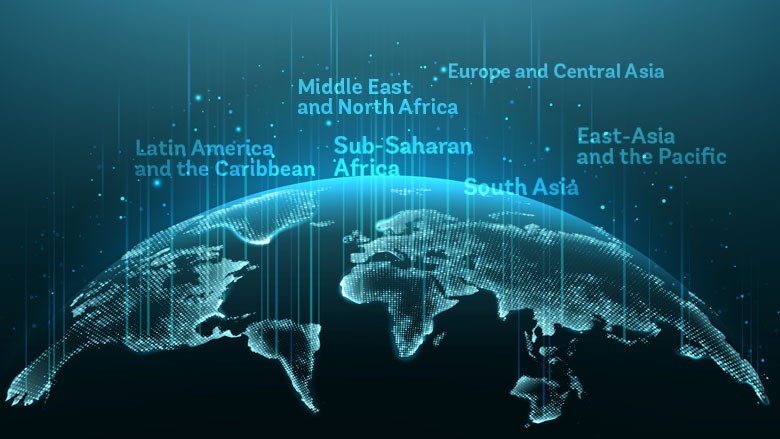 trends in Africa, East Asia and the Pacific, Europe and Central Asia, Latin America and the Caribbean, the Middle East and North Africa, and South Asia.
trends in Africa, East Asia and the Pacific, Europe and Central Asia, Latin America and the Caribbean, the Middle East and North Africa, and South Asia. These reports are issued the week before the World Bank-International Monetary Fund Annual Meetings in Morocco, October 9-15.
Infrastructure, economics, and a sustainable future: A Chief Economist’s perspective
In the 1990s, I embarked on a journey that took me from the classrooms of Paris to the dusty countryside of Paraguay. Little did I know then that my diverse experiences, from peddling goods door-to-door to advising governments, would shape my role as an economist specializing in infrastructure and development. Now, as the Chief Economist for Infrastructure at the World Bank, I stand at the intersection of a complex global landscape.
 Netherlands for the World Bank
You must be logged in to post a comment.