Every year, the world produces over two billion tonnes of municipal waste, a figure expected to rise by 73 percent to nearly four billion tonnes by 2050. Managing this surge will be a major investment and policy challenge for cities in low- and middle-income countries.
Despite increasing food production over the past three decades, 58% of Africans remain food insecure. Transport is an often-overlooked contributor to this challenge. Poor transport connectivity, failures at critical ports and border crossings, and high trade costs create long food supply chains that fail to reliably get staple products to people.
The idea behind debt-for-development swaps is straightforward: A country exchanges its expensive debt for cheaper debt, often supported by a credit enhancement like a guarantee, and then redirects the savings into development spending.
In national parks and ecological corridors globally, community champions are fostering harmony between people, wildlife, and other biodiversity, while creating jobs and other economic opportunities in their local areas.
The Global Wildlife Program (GWP) is one of the largest global partnerships created to support country-led initiatives that tackle illegal and unsustainable wildlife trade, mitigate human-wildlife conflict and zoonotic spillover risk, and promote wildlife-based livelihoods. With funding from the Global Environment Facility, the World Bank-led program works with community champions across 38 countries, including in South Africa, Indonesia, Mali, and Ecuador.
Dhaka, May 14, 2025 — The World Bank’s Board of Executive Directors today approved $270 million financing to bolster Bangladesh’s flood recovery efforts and enhance its resilience to future disasters, including support for constructing and rehabilitating critical infrastructure, strengthening agricultural system and improving livelihoods in areas devastated by the August 2024 floods.
Where villagers once struggled with basic tools and meager earnings, they now use modern electric machinery to create valuable finished products.
From increased rice production and reduced transportation costs, to booming sunflower oil businesses, access to reliable power is boosting local economies.
Tanzania is bringing its vision of universal electrification to reality with support from a $550 million International Development Association investment.
When African Heads of State, government representatives, private sector leaders, development partners, and civil society participants gathered in Tanzania for the Mission 300 Africa Energy Summit, they did so against the backdrop of a continent that has seen off-grid solar solutions revolutionize energy access—with remarkable progress made and significant potential yet to be tapped.
Social protection and labor programs help households and workers manage crises, escape poverty, navigate transitions, and seize employment opportunities.
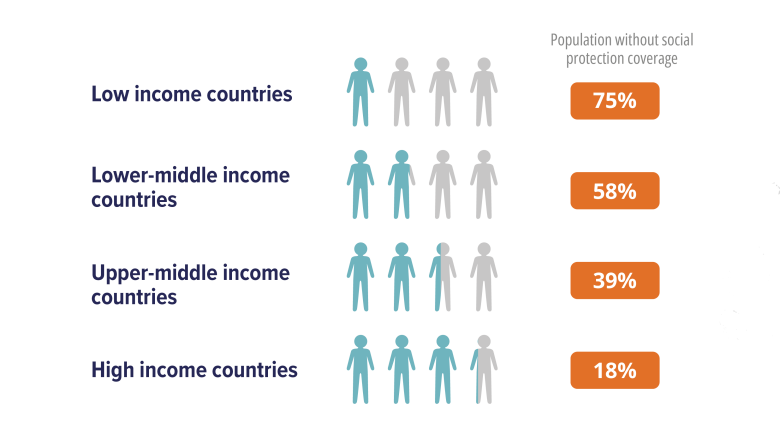
Despite recent progress, three in four people in the poorest countries have no social protection coverage. Across low- and middle-income countries, 2 billion people remain inadequately covered.
The World Bank is committed to scaling up social protection programs, working with governments and partners, to reach 500 million more people by 2030.
Today, more people have access to social protection than at any point in history. Over the last decade, 4.7 billion people across low- and middle-income countries gained access to social protection. However, critical gaps remain. Two billion people in those countries remain uncovered or inadequately covered by social protection.
The State of Social Protection Report 2025: The 2-Billion-Person Challenge documents advances and challenges to strengthening social protection and labor systems across low- and middle-income countries and discusses avenues to gradually close the coverage and adequacy gap for the world’s poorest.
What is social protection?
Social protection is the set of public measures that protect individuals and families against economic and social distress, with the aim of ensuring a minimum level of wellbeing for all. The three pillars of social protection—social assistance, social insurance, and labor market programs—support households and workers in handling crises, escaping poverty, facing transitions, and seizing employment opportunities. Well-designed social protection programs have a high return on investment, support long-term human capital and economic growth, and help people become more self-reliant. For every dollar transferred to poor families, there is an estimated multiplier effect of $2.50 in the local economy.
Social protection programs have expanded to 4.7 billion people
Social protection and labor programs support more people than ever. Over the past decade, low- and middle-income countries have expanded social protection to cover a record number of 4.7 billion people, a historic high. Coverage has increased by 10 percentage points – from 41% to 51% of the population between 2010 and 2022, with significant gains among the poor in low income countries.
Expansion of social protection 2010-2022: Coverage more than doubled in low income countries but remains low
During the COVID-19 pandemic, emergency social protection responses reached 1.7 billion people in developing countries, demonstrating the importance of shock-responsive systems. Countries with robust delivery infrastructure prior to the pandemic responded more effectively, emphasizing the need for proactive investment.
Coverage gaps remain substantial across the world
Today, 2 billion people in low- and middle-income countries remain uncovered or inadequately covered by social protection, including over 1 billion people in Africa and South Asia alone.
2 billion people in low- and middle-income countries remain uncovered or inadequately covered:
Three out of four people in low-income countries receive no form of social protection, and even in lower-middle-income countries, more than half of the population remains uncovered.
Social protection is at its lowest where it is needed most: among the poorest households in poorer countries:
Closing gaps in social services will take years
At current growth rates, it will take 18 years to achieve full coverage for those living in extreme poverty and 20 years to cover the poorest 20% of households in low- and middle-income countries.
Adequacy of benefits is uneven
For about 400 million people social protection benefits are so meager that they may not help recipients escape poverty or cushion the blow of unexpected shocks. In low income countries, social assistance transfers represent just 11% of the income of poor households.
Today, gender disparities persist with women receiving 81 cents for every $1 received by men on social protection benefits, on average, across a sample of 27 countries.
Unreached populations are disproportionately concentrated in fragile, conflict-affected, and hunger-prone regions of Africa, South Asia, and the Middle East.
Investing in employment programs is key
Social services and labor programs – such as public works, unemployment insurance, and job placement services – can greatly improve job opportunities and incomes for the poor. They can help the poor become more productive and prepare them with the right skills. Their impact, however, is often limited by low funding and designs that don’t account for local circumstances. Currently, spending on labor market programs is only 0.25% of GDP on average.
Policy recommendations
To accelerate progress, governments can take three policy actions, tailored to each country’s context, capacity, and fiscal restraints:
Expand coverage by investing limited resources, particularly in low-income countries, in infrastructure such as databases, digital payments, and case management systems to effectively support those in need.
Tailor support to help people, especially in middle-income countries, move beyond survival toward self-reliance.
Build shock-responsive systems by strengthening data, payments, and early warning tools to provide timely support and employment stability during crises.
To help fund these recommendations, the report notes that using existing resources more efficiently could make a big difference. For instance, redirecting cash transfers to benefit the poor could supply nearly half of the funding required to cover the bottom 20 percent of the population with social protection.
The World Bank is committed to scaling up social protection programs, working with governments and partners, to reach500 million more people, half of them women, by 2030.




 Netherlands for the World Bank
You must be logged in to post a comment.