Netherlands for the World Bank

Your guide to the World Bank Group

Netherlands for the World Bank

Build, Employ and Protect: Using Social Protection to Invest in People in a Changing World

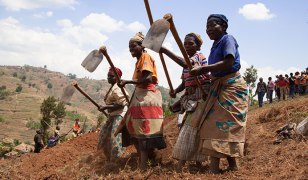
In a small community off the coast of Sierra Leone, Salamatou Bangura often struggled to gil-improving-social-networks-for-ugandan-farmers-feed her children. Though she worked long hours buying and selling seafood from the local fisherman in her village, until recently, it wasn’t enough. “I couldn’t afford to cook every day,” she recalls.

That all changed when she began to receive $10 every month through a social safety net program for extremely poor households. Bangura began using the money to put food on the table, pay school fees, and invest in her business. And when tragedy struck, and the family home burned down, Bangura used the money to rebuild, all the while ensuring that her children remained well-fed and in school.

Continue reading

eC2: Scoping and Design of Integrated Data Platform.

Deadline: 10-Aug-2019 at 11:59:59 PM (Eastern Time – Washington D.C.) Data-for-Development_cover-image_web

The World Bank (WB) is supporting the Government of Indonesia to develop a programmatic response to the challenges of sustainable urbanization. City Planning Labs (CPL) is one such Bank Executed Technical Assistance initiative that aims to support municipal governments to build capacity for a data-driven approach to city planning, enabling the development of smart, inclusive, and sustainable cities. Given the success of the interventions in two Indonesian cities namely Kota Semarang and Kota Denpasar, CPL has received multi-year support from the Indonesia Sustainable Urbanization (IDSUN) Multi-Donor Trust Fund (MDTF) to scale-up the initiative.

Continue reading

Where does the money go? Examining public spending in Afghanistan

Public spending in Afghanistan is equal to more than half of the economy’s output.210415_kabul_national_institute_of_management_and_aministration_nima_003 Government and international partners spend around $11 billion, in an economy that produces around $19 billion of output per year .

With such high levels of public spending, it’s worth understanding where all that money is going. We try to provide some answers in our new Public Expenditure Update. Continue reading

New World Bank online course tackles the future of work, preparing for disruption

The ever-increasing pace of the development of artificial intelligence is having a shutterstock_425107195profound impact on the workforce. Jobs that have been performed by humans for decades or centuries are becoming obsolete when robots enter the jobsite.  At the same time, new jobs become available that previous generations could not even fathom. Failure to prepare for these changes can have catastrophic impacts on economies.

Based on the 2019 World Development Report, the World Bank’s new course on the Future of Work will explore the various changes that result from advances in technology, what this means for the current and future workforce, and how we need to prepare for these changes.

Continue reading

Financial policy governance after the crisis—putting new wine into old bottles

Walter Bagehot ([1873], 2000) famously commented in his book Lombard Street on the 8206710580_35dfe7c37e_k.jpgneed to adapt a central bank’s governance structure to its changing purpose, writing that “‘putting new wine into old bottles’ is safe only when you watch the condition of the bottle, and adapt its structure most carefully.” This metaphor is particularly useful in understanding new and emerging challenges involved in tailoring the structure of financial policy governance in the post-crisis era.

Continue reading

Pre-results Review at the Journal of Development Economics: Lessons learned so far

About the JDE Pre-results Review pilot

turned on white tablet computer at globe share graph

In March 2018, the Journal of Development Economics (JDE) began piloting Pre-results Review track (also referred to as “registered reports” in other disciplines) in collaboration with the Berkeley Initiative for Transparency in the Social Sciences (BITSS). Through this track, the JDE reviewed and accepted detailed proposals for prospective empirical projects before results were available, offering a commitment to publish the resulting papers regardless of their findings.

Continue reading

eC2: Social Protection and Forced Displacement Research

Deadline: 15-Aug-2019 at 11:59:59 PM (Eastern Time – Washington D.C.)index

The fundamental question to be answered in this exercise is: What are the possible and feasible alternatives and combinations for the alignment of SSN and Humanitarian assistance, what are their potential advantages and disadvantages, under what circumstances, and for what ends, are the various alternative arrangements likely to be most suitable and effective? Develop and validate a model to describe and understand the effectiveness of possible options and entry points for the alignment of SSN and Humanitarian assistance.

Continue reading

eC2: DRONE TECHNOLOGY FOR MONITORING INDEPENDENT PALM OIL SMALLHOLDERS PRODUCTION

Deadline: 31-Jul-2019 at 11:59:59 PM (Eastern Time – Washington D.C.) WDR-2019-woman-with-laptop-and-drone.jp

The overall goal of this project is to establish new method on monitoring independent palm oil smallholder. The selected vendor is expected to recommend a method for smallholder monitoring using drone image advice and data service for smallholders, including develop an effective data distribution to smallholder farmers, cost per farmers, and payment collection system from smallholder farmers.
Specifically, the project will conduct aerial mapping of a minimum 15,000 hectares of smallholder farmland (each with approximately one to three hectares of land) and distribute image data to a minimum 1000 of independent smallholder farmers.
This will include:
– aerial mapping of a minimum 15,000 hectares of smallholder farmland,
– image analysis and interpretation of the image captured by the aerial mapping
– Provide report and recommendation for scale up the use of drone for smallholder monitoring, cost per farmer, effective data distribution and payment collection system from smallholders.

Continue reading