Economic Cost of Natural Gas – Myanmar

The Republic of the Union of Myanmar has received a grant from the Energy Sector Management Assistance Program (ESMAP) administered by the World Bank toward the cost of the Electric Power Project, and intends to apply part of the proceeds for consulting services.

The consulting services (the Services) include the following scope:

1. Review Myanmars natural gas supply and demand balance for the next 10 years or longer;
2. Develop appropriate methodologies for determining economic costs for supplying natural gas into the domestic Myanmar market;
3. Quantify the economic cost of supplying natural gas at certain offtake points from the gas network; and
4. Conduct consultative meetings/workshops/training events to obtain information and share findings and results.

See full tender here: Economic Cost of Natural Gas – Myanmar

Expression of Interest Deadline: 11 March 2015
Renewable Energy Program Investment Preparation – Bangladesh

Bangladesh has recently been selected as one of the 14 new countries for the Scaling up Renewable Energy Program in Low Income Countries (SREP) under the Climate Investment Funds. The objective of the SREP is to pilot and demonstrate the economic, social and environmental viability of development pathways in the energy sector by creating new economic opportunities and increasing energy access through the use of renewable energy.

Continue reading

Boosting Solar Energy Capacity in Africa

Press release published on the World Bank website. 

The IFC prides its self on funding innovation, this makes for  interesting opportunities for Dutch companies developing innovative products who are looking for a strong partner.

“We take innovative approaches to our investments, supporting large, potentially transformative projects. We also help developing countries expand the use of cutting-edge technologies, such as concentrated solar power”-

powering-africa-inside-banner

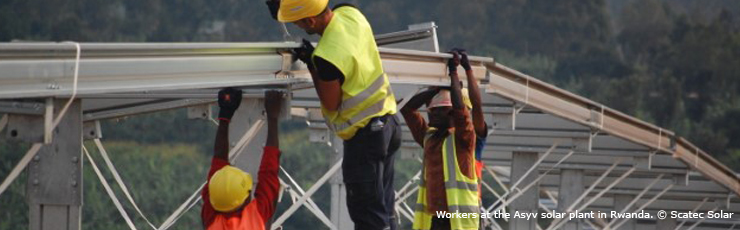
Sub-Saharan Africa is rich in energy resources but its potential remains mostly untapped. Despite the abundance of sunlight, solar projects have been developed slowly and often inefficiently.

Weak competition and high transaction costs are some of the obstacles that hamper the progress of the technology.

Continue reading

Waste to Energy Consultant – Bangladesh

IFC is looking forward to hire one firm/institution for Short Term Consultant (STC) work to support the establishment of the Green Energy Knowledge Hub in Bangladesh.

This Knowledge Hub will serve as the anchor to provide information to the industry on the latest developments, support in operation of existing plants and help in putting up new plants. The Knowledge Hub will also offer space for interested vendors to display their products/ technology.

See full tender here: Waste to Energy Consultant – Bangladesh

Expression of Interest Deadline: 29 January 2015

Off-Grid Solar Market Report

Since 2007, under the programmatic framework of Lighting Africa, Lighting Asia, and Lighting Global, IFC and the World Bank (the World Bank Group, WBG) have built a portfolio of country program platforms to directly support the development of a vibrant off-grid solar devices market. The WBG off-grid solar devices market support programs seek to lower first-mover risk for both industry members and end-users, addressing barriers to market development, and enabling a competitive sustainable commercial solar devices industry to rapidly scale.

It is the intent of the WBG to hire a Consultant with a demonstrated deep understanding of the dynamics, players, trends and drivers of the off-grid solar devices market. The Consultant should be in position to expand the WBG and off-grid solar device industrys comprehensive understanding of the markets progression over the past three years, and translate those insights into a credible and insightful view of how the industry will develop and markets will evolve in the next 3 years.

Continue reading

Energy Water Development Program – Central Asia

The World Bank wants to evaluate the Central Asia Energy and Water Development Program (CAEWDP).

The objective of the evaluation will be two fold under the overall purpose of improving the development results of the CAEWDP Program and increasing its impact in building energy and water security in Central Asia.

The first objective is to evaluate the implementation of the first phase of the CAEWDP Program (SECO Seed Single Donor Trust Fund), as initially envisaged. The assessment will review baseline, analytic and advisory activities, and completed activities against targets specified in the trust fund agreement. Continue reading

Energy & Electrification Consultant – Myanmar

The development of the National Electrification Plan (NEP) for Myanmar supported by the World Bank (WB) through a series of capacity building and Technical Assistance (TA) activities includes a review of electricity tariffs and subsidy mechanisms. The 2nd Phase of Poverty and Social Impacts Analysis (PSIA) outlined here is intended to support this process by deepening the initial round of PSIA analysis completed in October 2014.

The qualitative analysis under Phase II has two complementary objectives.

1. To provide more in depth inputs to the design of subsidy schemes/tariff structure with a focus on:
a. Improved access for poor and marginalized areas and households under NEP (including subsidies for village connections under the SRE approach and subsidies for home connection in urban wards).
b. Providing adequate support to SMEs to minimize negative impacts noted under Phase I for medium sized businesses with a focus on the quality and reliability of electricity service.

Continue reading