
Data visualizations do more than display numbers; good data visualizations tell a story not only to educate, but also to engage and inspire their audiences. Data is crucial for informing knowledge work and measuring the impact of sustainable development programs. The Global Partnership for Sustainable Development Data and the World Bank’s Development Data Group often tell stories with data, and the two organizations wanted to see what data storytellers worldwide could do with development data.
Tag Archives: President
Transforming Development Policy at Scale Demands Ambitious Reforms to Public Administration
STORY HIGHLIGHTS 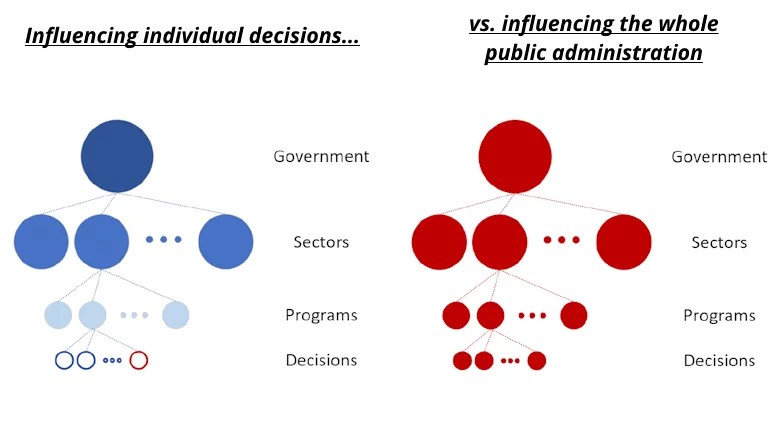
- Public servants make an estimated half a billion policy decisions per year. Influencing these decisions at the scale needed to achieve the Sustainable Development Goals will require strengthening entire government administrations.
- Development policy is only as effective as the government agencies that implement it, and the performance of these agencies varies widely within low- and middle-income countries. This wide variation in performance points to huge opportunities for improving public policy by strengthening the administrative environment around it.
- One promising new approach to influencing public policy—known as government analytics—is to use governments’ own data to understand how well government is functioning and diagnose ways to strengthen it. The World Bank’s new Government Analytics Handbook offers a blueprint for governments and agencies around the world to take up this innovative approach.
With a target of 2030, the world has only six years left to reach the Sustainable Development Goals (SDGs). By the UN’s latest accounting, progress on many of the goals has stalled or even gone into reverse. The challenge may look steep or perhaps even insurmountable, but there is one public servant who provides us with inspiration for how the world can still meet the goals: James Bond.
That was the surprising claim by Daniel Rogger, a Senior Economist and Research Manager at the World Bank, at a recent Policy Research Talk on the topic of how to best reform public administrations to achieve greater development impact. As Rogger explained, while James Bond may be a fictional movie character, he exemplifies the characteristics of high-performing government servants everywhere—a strong sense of autonomy, a high mission orientation, and a strong drive to seek out novel solutions in ever-changing circumstances. He emphasized that if we don’t have heroes in government, public policy simply won’t be implemented effectively, and we will fail to achieve the SDGs.
To illustrate why the performance of civil servants is so central, Rogger sketched out a rough estimate of how many decisions bureaucrats around the world must make every year in implementing government policy. The answer: half a billion. As Figure 1 illustrates, influencing these decisions at the level of an entire government—rather than at the level of individual decisions, programs, or sectors—holds the key to ramping up development effectiveness.
Figure 1: Contrasting Paths to Influencing Policy Decisions
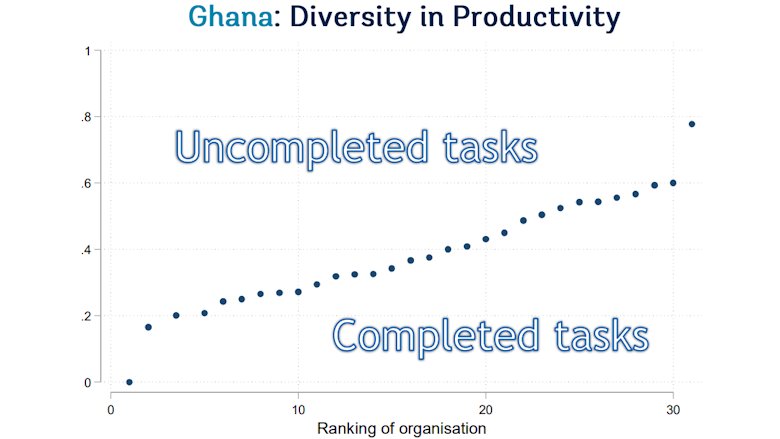
For example, Rogger and colleagues examined the productivity of Ghana’s 31 core public institutions and found large discrepancies between them. A survey of nearly 3,000 Ghanaian civil servants assessed the completion of 3,628 projects and found large disparities in the percentage of uncompleted tasks across ministries (Figure 2). “The value of any new investment is going to be heavily mediated depending on which ministry you’re working with,” said Rogger. “If you work with any but the very best, you immediately lose 40 percent or more of your potential development impact.”
As Rogger explained in a previous talk, this pattern of wide variation in bureaucratic performance is common, especially among the low- and middle-income countries where the SDGs are most pressing. Rogger sees this as a glass half full—these large differences in bureaucratic effectiveness offer great potential for reform.
Figure 2: Bureaucratic Productivity Varies Dramatically
Carrot or Stick? Diverging Approaches to Promoting Accountability in the Civil Service
Over the last few years, Rogger and his colleagues at The Bureaucracy Lab have devoted themselves to identifying the types of reforms that can create high-performing public servants—the James Bond-equivalents in education, health, and every other sector of government.
Promoting accountability is one way to do this, and Rogger contrasted the results of two reform programs—one relying on centralized, punitive accountability and another on positive forms of motivation with greater autonomy—to demonstrate what works in practice.
The first example comes from Pakistan and highlights the pitfalls of relying too heavily on centralized, punitive accountability systems. Over a six-year period, the provincial government of Punjab sought to boost the performance of the education sector, in part by putting in place a strong management information system. Detailed data were used to flag underperforming teachers and educational administrators, leading to de facto punishment. But Rogger and his fellow researchers found that schools where punishments were doled out soon reverted back to their pre-punishment level of performance, resulting in no long-term improvements in attendance, test scores, or other measures of educational performance.
Rogger contrasted this to an example from Liberia, which rolled out its first comprehensive civil service appraisal system in 2016 as part of a series of reforms to rebuild the civil service following decades of civil war. Instead of a hierarchical and punitive approach to performance management, the new system was designed to recognize staff achievements and generate open dialogue as a means to give staff positive motivation. Researchers found that the introduction of the appraisal system helped reduce absenteeism and turnover and also increased staff satisfaction.
An additional example from Ghana further highlights the benefits of civil service reforms that emphasize positive reinforcement and autonomy rather than hierarchical authority. The World Bank collaborated with Ghana’s Office of the Head of Civil Service to train civil servants on creative problem solving and innovation. Researchers collected data over the course of two years and found that classroom training focused on individuals—as opposed to teams—helped produce innovators, who in turn helped create more collaborative and innovative organizational cultures.
Public Administration Reform Tied to Better Government Analytics Can Boost Development Progress
Drawing out general lessons from existing research, Rogger argued that reforms should focus on building up the professional features of a civil service—clarifying duties, identifying talents, and fostering strong professional values. Nevertheless, he emphasized that there is still much more to learn about building effective public administrations.
Given the stakes involved, Rogger issued a challenge to the World Bank and the wider development community to make much greater investments in building the knowledge base. Three areas of focus could produce outsized development payoffs.
The first is making government analytics central to public administration reform. Government administration is unique, complex, and highly diverse, and detailed microdata can help governments accelerate how quickly they can identify areas for improvement, take action to remedy deficits, and spread best practices across agencies.
A second focus is on the World Bank’s own work with government partners. Bank projects and financing can be paired with efforts at building public administration by providing officials with inspiration, tools, and comparative data. As Rogger colorfully described it, World Bank staff can be the “Q” to the James Bonds of developing countries’ civil service—providing the best tools available to allow civil servants to excel at their jobs.
Finally, a third area of work involves further scaling up a “Trial and Adopt” approach that the Bureaucracy Lab has been using for years. The approach involves working directly with public officials on the specific problems they face, and bringing data, evidence, and evaluations to bear that allow for mid-course corrections, learning by doing, and scaling up successes.
As a down payment on this substantial investment, Rogger and his colleagues have recently published The Government Analytics Handbook and associated website, which bring together the latest evidence and practitioner insights on how to leverage data to make governments work better. The book covers a range of microdata sources—such as administrative data and public servant surveys—as well as tools and resources for undertaking the analytics, with the goal of helping governments take a data-informed approach to diagnose and improve how public organizations work.
Many practitioners have already found great value in the tools now made systematically available in the book. As Pedro Guerra, Chile’s Deputy Director of Civil Service, previously remarked, the public servant surveys are “an ideal civil service survey diagnostic to pursue evidence-based civil service management reforms.”
“Our job is not to constantly seek out ways to punish public servants when they get it wrong,” said Rogger. “Rather, our best chance to achieve ambitious development goals is to invest in helping them get their administration right to give them the freedom to succeed.”
Multimedia

VIDEO MAY 23, 2023
Evidence to Fix Bureaucracies: The Sequel
Within reach: Navigating the political economy of decarbonization
Political economy can be a sensitive topic. At an individual level, why people do what they do and think what they think is inherently personal, private even. But collectively, people’s thoughts, feelings and behaviors shape current and future events.
It is tempting to avoid analyzing or addressing the political economy for fear of creating unnecessary controversy. But for climate policy makers, this stance will not hold, as shown by the successes and failures of the past decade.
Digital pathfinders: The role of youth in the online gig economy
Can you imagine a job where you can decide where to work, when to work, and which projects to work on? According to our recent data analysis, this is exactly how 243 million youth around the world are challenging the traditional career path, particularly in developing countries where they seek higher pay and jobs that are not easily available close to home.
Breaking Barriers in Sri Lanka: A Woman’s Journey to the Top | Talking Development
Women Helping Women Out of Poverty—One Business at a Time
At 2 a.m. in the quiet streets of Balykchy, a small town in the Kyrgyz Republic, most people are deep in the embrace of their dreams.
But for Altynai Arzymatova, a 34-year-old single mother of three, the day is already getting started.
Building Green: Sustainable Construction in Emerging Markets
At a Glance 
Switching to greener technologies in construction and operation of buildings and materials, combined with more climate-friendly capital markets, could reduce the construction value chain’s carbon footprint 23 percent by 2035, while creating investment opportunities in emerging markets, according to a major report from the International Finance Corporation.
Publication: Commodity Markets Outlook, October 2023: Under the Shadow of Geopolitical Risks
Abstract
The conflict in the Middle East—the latest of an extraordinary series of shocks in recent years—has heightened geopolitical risks for commodity markets, in an already uncertain global environment. Before the conflict began, voluntary oil supply withdrawals by OPEC+ producers pushed energy prices up 9 percent in the third quarter. As a result, the World Bank’s commodity price index rose 5 percent over that period and is now 45 percent above its 2015-19 average. For now, the war’s impact on commodity prices have been muted. Prices of oil and gold have risen moderately, but most other commodity prices have remained relatively stable. Nevertheless, history suggests that an escalation of the conflict represents a major risk that could lead to surging prices of oil and other commodities. A Special Focus section provides a preliminary assessment of the potential impact of the conflict on commodity prices. It finds that the effects of the conflict are likely to be limited, assuming the conflict does not widen. Under that assumption, the baseline forecast calls for commodity prices to decline slightly over the next two years. If the conflict does escalate, the assessment also includes what might happen under three risk scenarios, relying upon historical precedents to estimate the effects of small, moderate, and large disruptions to the global oil supply. The magnitude of the effects will depend on the duration and scale of the supply disruptions.
The World Bank’s Bold New Vision
On October 13, 2023, at the World Bank-IMF Annual Meetings in Marrakech, Ajay Banga delivered a landmark address on the Bank’s new vision and mission and the roadmap to achieve it. Read the full remarks, watch the video, and see highlights below.
Climate Action Game Changers: Urban Transport
Your commute to work, the family gathering, the food on your table, and the goods you buy – all rely on transport and our lives are unthinkable without it. But transport also represents a growing threat to our planet. Buses, cars, planes, ships, and trucks burn fossil fuels, and this causes climate change.
 Netherlands for the World Bank
You must be logged in to post a comment.