
How the private sector is rising to meet the challenges of a global crisis
Across Africa, the private sector is rising to the pressing challenges posed by the 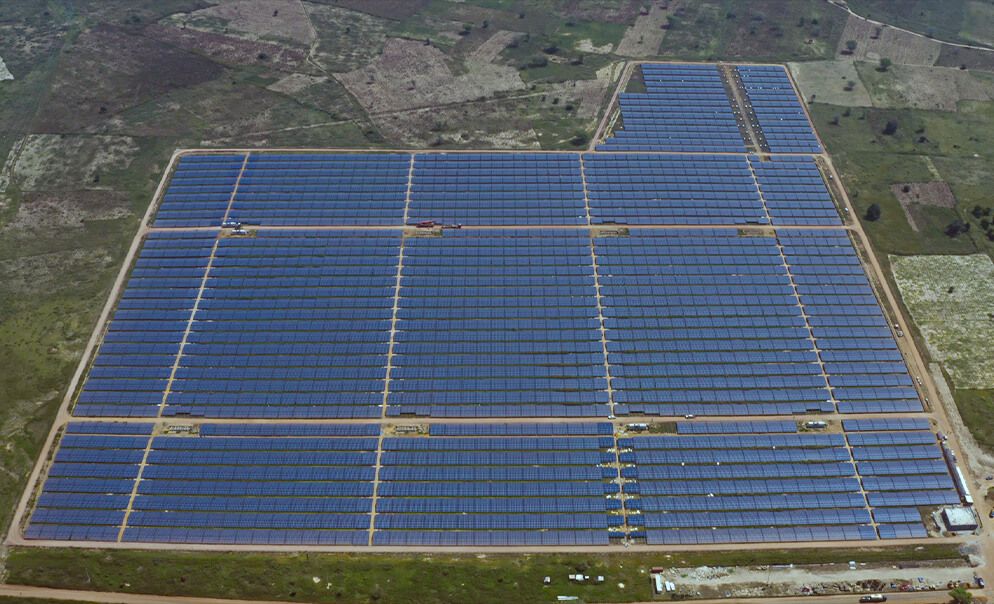 global climate crisis.
From housing and energy to transport and agriculture, businesses on the continent are delivering strategies, technologies, and projects that are reducing the human impact on the environment, while supporting jobs, reducing poverty, and furthering development.
Private sector support is critical because many governments, particularly in developing countries, struggle to cover the costs of the products and services needed to address the impacts of climate change, pollution, and environmental degradation on lives and livelihoods.
Bird’s-eye view of the Kahone Solar Plant. Photo: Meridiam
Climate is a strategic pillar for IFC, which is committed to growing its climate-related investments to an annual average of 35 percent of its own-account, long-term commitments between 2021 and 2025. IFC also works with financial institutions to finance projects that will support mitigation and adaptation.
In fiscal year 2022, IFC delivered $4.4 billion in climate finance globally and mobilized an additional $3.3 billion from other sources, with $2.1 billion supporting Africa’s green transition.
Below are four examples drawn from across Africa that showcase how the private sector is responding to the needs of consumers, communities, and the planet as climate change threatens to reverse many of Africa’s hard-fought development gains.
In Senegal, here comes the sun
What’s the size of 92 soccer fields and provides power to about 540,000 people in Senegal?
The answer: two solar power plants located in Kahone and Kael in western Senegal, which came online in 2021 and have a total generation capacity of 60MWac.
With an average of 125 days of sunshine annually, Senegal is one of the world’s sunniest countries. The Kahone and Kael plants are taking advantage of the blue skies, providing power at some of the lowest prices in sub-Saharan Africa and avoiding roughly 89,000 tons of CO2 emissions per year.
Despite Senegal’s embrace of green energy, however—the country already sources 32 percent of its power from renewable sources—one in five Senegalese still lack access to electricity and the bulk of the grid still runs on imported fossil fuels.
“The biggest hurdle to renewable energy development in Africa is the regulatory framework,” said Jeylani Diop, managing director of SolarSen, the Senegalese company operating the Kahone and Kael solar plants. “Putting in place the right policies in key areas such as procurement, taxation, land, and electricity purchase conditions is a key prerequisite to entice private investors to develop solar energy projects in Africa.”
This is where Scaling Solar, a World Bank Group initiative aiming at ramping up the uptake of privately funded solar power solutions in developing economies, is providing support.
Scaling Solar offers a suite of advisory, tendering, financing, and guarantee services to make privately funded grid-connected solar projects operational within two years and at competitive tariffs. It operates in Senegal and Zambia and is being rolled out in Côte d’Ivoire, Niger and Togo.
Workers in the Kahone Solar Plant. Photo: Meridiam
Scaling Solar helped the Senegalese Electricity Regulatory Commission implement a competitive and transparent international bidding process. Which awarded the Kahone and Kael plants to French utility giant Engie and asset manager Meridiam, which resulted in an unprecedented price of 25 CFA francs per kWh, one of the lowest prices for electricity in West Africa. IFC, the Finland-IFC Blended Finance for Climate Program, the European Investment Bank, and Proparco financed the Kahone and Kael plants.
But ramping up solar energy in Africa is a complex undertaking that demands complementary solutions. This includes increasing innovation and investments in battery storage solutions to avoid grid congestion, which helps ensure efficient electricity distribution.
Battery storage systems are helping countries worldwide better integrate renewable energy into their power systems by enabling energy from solar, wind, and other renewable sources to be stored until customers need power most.
According to the International Renewable Energy Agency (IRENA), energy storage deployment in emerging markets is expected to increase by over 40 percent annually from 2020 until 2025, providing a major boost for renewables.
For Senegal, leveraging regional integration initiatives such as the West African Power Pool (WAPP) can also increase the development of solar energy on the continent.
“This framework, which promotes and develops electric power generation and transmission infrastructure in West Africa, can allow developers who have bankable projects to come in and create markets in the sub-region by supplying electricity to several countries,” Diop said.
There is still a long road ahead. Despite Africa’s huge solar potential, the continent has received only 2 percent of global renewable energy investments over the last 20 years. But with the right reforms, Africa has an immense opportunity to attract additional investment into renewables and power its future development.
 Netherlands for the World Bank
You must be logged in to post a comment.