
Category Archives: WBG News & Reports
World Bank Financing for COVID-19 Vaccine Rollout Reaches $2 Billion
Financing for the poorest countries is on grant or highly concessional terms

WASHINGTON, April 20, 2021— The World Bank announced today that it has reached $2 billion in approved financing for the purchase and distribution of COVID-19 vaccines for 17 developing countries. This financing is part of the $12 billion envelope over 24 months for developing countries to acquire and deploy vaccines and strengthen their vaccination systems. For poorer countries financing is on grant or highly concessional terms. The Bank expects to support 50 countries with $4 billion financing for COVID-19 vaccines by mid-year.
What are countries doing to prepare for large scale vaccine rollouts?
Message of His Holiness Pope Francis to the World Bank Group and International Monetary Fund
I am grateful for the kind invitation to address the participants in the World Bank Group and  International Monetary Fund 2021 Spring Meetings by means of this letter, which I have entrusted to Cardinal Peter Turkson, Prefect of the Holy See’s Dicastery for Promoting Integral Human Development.
Webinar Recap WBG/IMF Spring Meetings
Key Green Transitions: How Systems Are Changing for People and Planet
Everyone should be able to live a sustainable life on a healthy planet. But the last six years have been the hottest on record. Record-breaking wildfires, droughts, floods and hurricanes have taken lives, damaged homes, hospitals and businesses. Meanwhile, COVID-19 took a heavy health and economic toll and pushed millions into extreme poverty.
COVID-19: Vaccines for Developing Countries
The rollout of COVID-19 vaccines in developing countries is critical to protecting lives, building human capital, and stimulating economic recovery. The current crisis is exacerbating inequalities throughout the world and, without access to vaccines, the gap will widen further.This event begins with voices of youth from around the world reflecting on the impact of the pandemic and their hopes for a speedy recovery with a return to school, friends, and family.World Bank Group President David Malpass then describes what vaccines mean for the world, what needs to be done to accelerate production and ensure safe and effective distribution to developing countries, and the importance of collaboration amongst all stakeholders for a sustainable and inclusive recovery
Webinar April 9th – COVID-19: Vaccines for Developing Countries
Working toward a green, resilient, and inclusive recovery 
At the close of the 2021 Spring Meetings, the Development Committee stressed that strong international coordination is urgently needed to contain the impacts of the COVID-19 pandemic, resume progress toward development goals, and lay the groundwork for green, resilient, and inclusive development.
WBG/IMF Spring Meeting Webinar Recap
Economic Recovery: Toward a Green, Resilient, and Inclusive Future
As countries rebuild their economies after COVID-19, it is fundamental that they see this as a unique opportunity to lay the foundation for a green, resilient, and inclusive future. These efforts were the theme of the event kicking off the Spring Meetings on Tuesday, Economic Recovery: Toward a Green, Resilient, and Inclusive Future.
2021 Spring Meetings Opening Press Conference
World Bank Group President David Malpass will address the press during the World Bank Group/International Monetary Fund 2021 Virtual Spring Meetings. He will share his views on the key outcomes from the Development Committee, as well as the G20 discussions. He will also report on the World Bank Group’s response to the global crisis caused by the COVID-19 pandemic.
This year, due to the coronavirus, the Management of the IMF and World Bank Group and their Executive Boards are adapting the 2021 IMF-World Bank Spring Meetings to a virtual format.
Website: The World Bank Group’s Response to the COVID-19 Pandemic
Rethinking Debt: Financing the Future Amid Crisis
On April 7th, the World Bank invited several leading experts to explore perspectives on a new global financial architecture for debt. Speakers discussed lessons from past restructuring efforts, the private sector’s role, and the increased need for debt transparency.
Webinar April 9th – COVID-19: Vaccines for Developing Countries
About the Event: LINK
The rollout of COVID-19 vaccines in developing countries is critical to protecting lives, building human capital, and stimulating economic recovery. The current crisis is exacerbating inequalities throughout the world and, without access to vaccines, the gap will widen further. Ensuring developing countries can access, as well as safely distribute vaccines, calls for strong partnership and cooperation at the national, regional & global levels. This event will explore:
A Roadmap for Building the Digital Future of Food and Agriculture
STORY HIGHLIGHTS
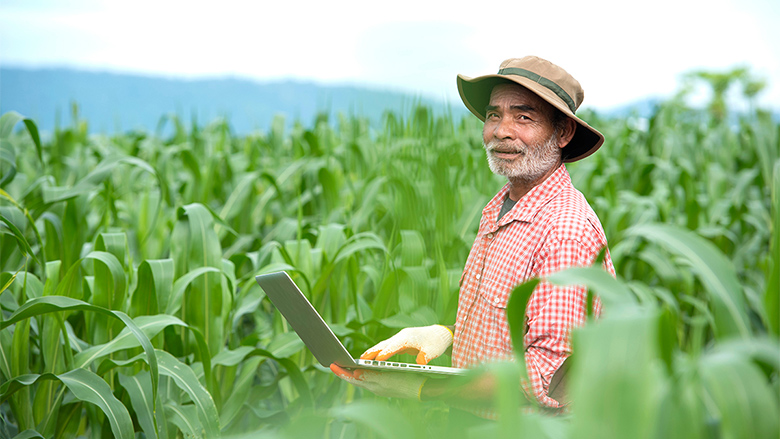
- Fair distribution of data can help ensure fair pay for farmers
- Digital agriculture can help improve yields and cut down on food loss and waste
- Digital agriculture allows consumers to choose healthier, more environmentally friendly food
Tackling the COVID-19 Pandemic of Inequality to Build a Green, Inclusive, & Resilient Recovery
‘We have to help countries improve their readiness for future pandemics.’
World Bank Group President David Malpass called on the world to move urgently toward opportunities and solutions that achieve a green, resilient, and inclusive recovery from the COVID-19 pandemic in a speech today that advances the World Bank-IMF Spring Meetings.
“Our collective responses to poverty, climate change, and inequality will be the defining choices of our age.”
Mr. Malpass delivered the speech virtually at the London School of Economics; it was followed by a discussion with students, moderated by Baroness Minouche Shafik, Director of the London School of Economics.
 Netherlands for the World Bank
You must be logged in to post a comment.