

Monetary policy is often portrayed as a technical lever—moving interest rates to manage inflation and aggregate demand. Yet recent evidence suggests its reach may extend far deeper into household life than previously imagined. Beyond spending and borrowing, central bank decisions might be shaping one of society’s most fundamental choices: whether and when to have children.
Across both advanced and emerging economies, fertility rates have fallen to historic lows. This demographic transition is transforming labor markets, altering savings behavior, and affecting long-term growth potential. As governments worry about aging populations and shrinking workforces, an overlooked question emerges: could monetary policy itself be influencing fertility—and, if so, what does that mean for economic development?
A global demographic shock with macro consequences
According to World Bank data, the world’s total fertility rate has declined from 4.7 children per woman in 1960 to just 2.2 in 2023—below the replacement threshold in over three-quarters of the global population (figure 1). In development terms, the demographic transition is a double-edged sword. Countries like Brazil, the Republic of Korea, and Thailand initially benefited from falling fertility through a “demographic dividend,” as fewer dependents freed resources for savings and investment. But that dividend fades once fertility falls below replacement, leaving an aging population and slowing productivity growth. For many emerging markets, the risk is “aging before affluence”—losing demographic momentum before reaching high-income status.
Figure 1. Global Total Fertility Rate, 1960–2023
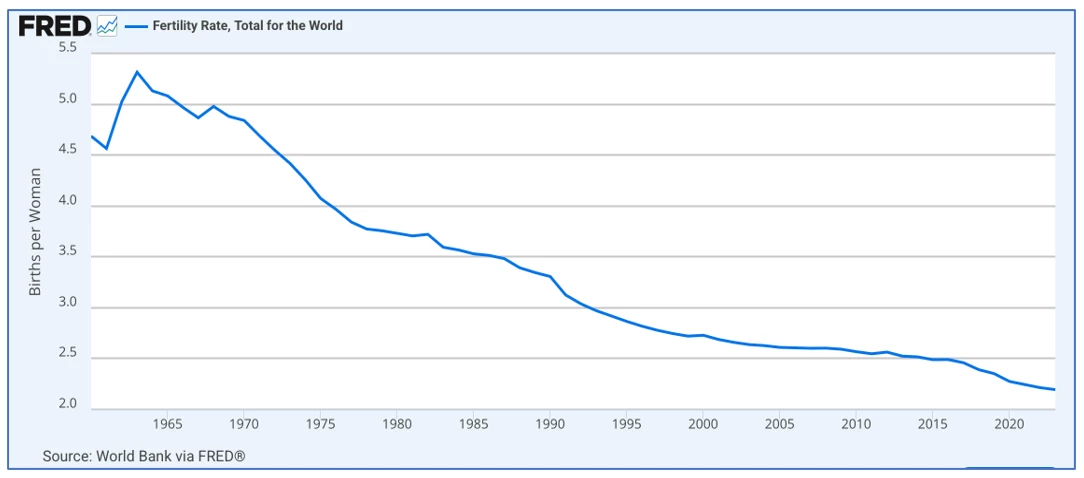
This decline is not merely social—it is macroeconomic. Slower population growth means fewer workers, lower potential output, and weaker consumption. A smaller labor force increases the dependency ratio, amplifying fiscal pressures on pensions and health care. For central banks, it erodes the economy’s neutral interest rate r*—the real interest rate consistent with the economy operating at full capacity and stable inflation—constraining their ability to stimulate demand. Over time, demographics may reshape the very structure of monetary transmission.
Yet the relationship does not end there. Policy itself can bend the demographic curve. Interest-rate decisions, by altering credit, housing affordability, and household confidence, may influence whether families decide to have children at all.
A new transmission channel: Monetary policy and fertility
The notion that monetary policy might affect fertility once seemed implausible. However, a recent pioneering study by the Bank of England’s Fergus Cumming and the US Federal Reserve’s Lisa Dettling has made that link tangible. Using detailed household data from the United Kingdom, the authors found that a 1-percentage-point cut in the bank rate during the Great Recession increased births by 2 to 5 percent among families with adjustable-rate mortgages. The mechanism is intuitive: rate cuts lower mortgage payments, ease liquidity constraints, improve household confidence, and affect the fertility rate positively. The opposite would happen in a tightening cycle.
It also occurs, however, that when low interest rates persist for extended periods and fuel housing and asset booms, the resulting price inflation can erode affordability for younger cohorts, penalizing would-be families and offsetting the very gains that easing was meant to deliver. In this way, short-term liquidity relief can evolve into a long-term affordability trap.
This complex “birth-rate channel” suggests that monetary impulses can reach far beyond investment or consumption—influencing the intertemporal decisions that underpin demographic and fiscal sustainability—and that the relationship is nonlinear: what begins as stimulus for family formation under constrained liquidity can, through asset-price dynamics, become a structural drag on fertility.
This pattern is also evident in emerging economies, where empirical studies suggest that fluctuations in credit and financial-inclusion conditions shape household fertility behavior more strongly where access to finance is uneven and social protection limited. In Brazil, while aggregate indicators show that in the 2010s the fertility rate continued to decline despite the strong growth in housing credit, micro-evidence from randomized housing-credit lotteries indicates that targeted access to affordable mortgages increased births among recipients. In China, easing household borrowing constraints has been found to raise fertility, while housing-price inflation and expanded financial-investment options suppress it. In Korea, research on young, unmarried adults found that the availability of housing support (for example, subsidized loans or special housing supply) is positively associated with intentions to have children, implying that housing-market constraints may inhibit childbearing decisions. In Türkiye, fertility declines when unemployment rises and during adverse economic conditions, consistent with procyclical movements with employment.
Together, these findings reinforce that macro-financial architecture and demographic behavior are deeply interconnected.
Demography as a policy factor
In conclusion, for central bankers, the demographic factor is not a side story. Population decline is a slow-moving structural shock that lowers potential output and reduces long-run real interest rates, making it harder to push policy rates below zero—when necessary—without distorting markets.
At the same time, causality also runs in reverse: the policy stance of today can influence the demographic trajectory of tomorrow. Fertility decisions feed back into the macro variables—labor supply, savings, and investment—that shape the environment in which central banks operate.
Recognizing the demographic dimension of monetary policy does not require widening central-bank mandates. It requires understanding how policy rates propagate through household expectations, fertility choices, and long-term macro fundamentals—and how those evolving fundamentals, in turn, reshape the policy landscape. Because these channels cut across both monetary and fiscal spheres, consistency between the two matters: without coordination, one arm of policy can easily undermine the objectives of the other. The institutional architecture needed to align these signals—and its implications for central-bank strategy, modeling, and communication—is the subject of part 2 of this blog post.
“Credit: World Bank Group. All rights reserved”
 Netherlands for the World Bank
You must be logged in to post a comment.