
The World Bank’s flagship report, “Waste Management in the Middle East and North Africa,” reveals that the region currently generates over 155 million tons of waste each year, a figure projected to nearly double to 294 million tons by 2050. Poor waste management costs the region around US$7.2 billion each year in environmental damage. Food waste alone causes US$60 billion in losses, in a region where one in six people faces severe food insecurity. The report analyzes the challenges and opportunities in the waste sector across the region. Through new data from 19 countries and 26 cities, the report recommends pathways to advance waste management systems, tailored to high-income, middle-income, and fragile/conflict-affected countries. It calls for investment to modernize waste systems, reduce food loss and promote measures in line with the principles of circular economy. The report highlights that up to 83 percent of the waste collected in MENA could be reused, recycled, or recovered for energy. Transitioning to a circular economy could also create better jobs, particularly in waste services and recycling, while turning today’s waste crisis into a driver of sustainable growth. The report analyzes the challenges and opportunities in the waste sector across the region. Through new data from 19 countries and 26 cities, the report recommends pathways to advance waste management systems, tailored to high-income, middle-income, and fragile/conflict-affected countries. It calls for investment to modernize waste systems, reduce food loss and promote measures in line with the principles of circular economy. The report highlights that up to 83 percent of the waste collected in MENA could be reused, recycled, or recovered for energy. Transitioning to a circular economy could also create better jobs, particularly in waste services and recycling, while turning today’s waste crisis into a driver of sustainable growth.
OVERVIEW
MENA countries face mounting pressures from fast‑growing populations, rapid urbanization, and rising consumption — leading to higher waste generation and waste mismanagement. The MENA region generates more waste than the global average, currently at 0.9kg/capita/day while the global average is at 0.79kg/capita/day. Mismanaged waste already causes an estimated US$7.2 billion per year in environmental damages.
While waste collection rates are relatively high (nearly 80 percent on average), recycling and treatment lag far behind. Less than 10 percent of waste is recycled, and more than two-thirds is mismanaged, fueling air, soil, and water pollution, marine litter, and serious health risks. The region also has the highest per-capita plastic leakage into the seas, with the Mediterranean among the world’s most polluted seas.
The report highlights three priorities:
- Scaling up financing, through user fees, public-private partnerships (PPPs) and extended producer responsibility systems;
- Reducing food and packaging waste; and
- Strengthening accountability coordination between national and local institutions.
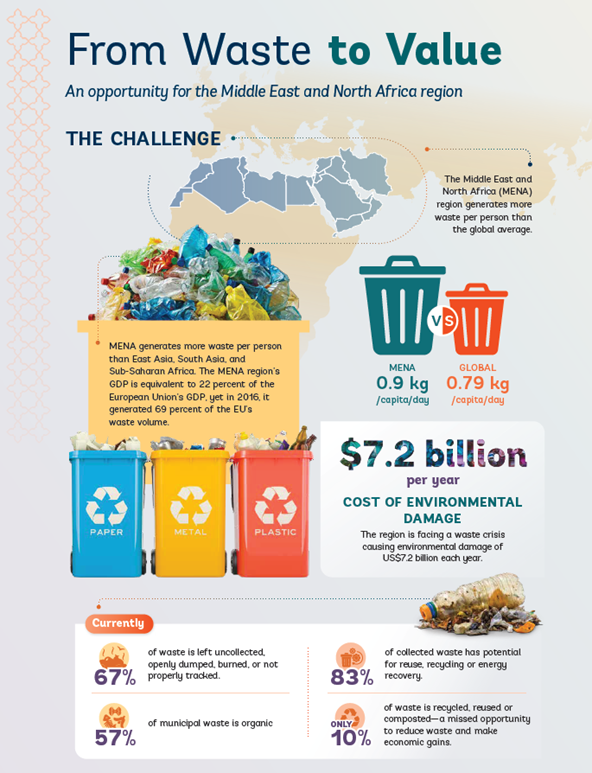
- The MENA region generates more waste per person per day than the global average (0.9kg/person/day compared to 0.79 kg/person/day)
- The region produces 155 million tons of waste annually — a figure expected to double by 2050 if no action is taken.
- Poor waste management leads to $7.2 billion costs of environmental degradation per year.
- Food waste alone costs the region $60 billion annually.
- The waste crisis threatens health, growth, and the tourism industry.
- Currently:
- Only 10% of the region’s waste is recycled, reused or composted.
- About 67% is waste is mismanaged (uncollected, openly dumped, burned or not properly tracked).
- 83% of collected waste has potential for reuse, recycling or energy recovery,
- Moving to a circular economy model could help MENA recover 83% of waste and create better jobs.
- A 1% reduction in waste generation could save $150 million annually.
- The solid waste management sector employs about 400,000 formal workers, with at least as many engaged informally across the region.
- To reduce environmental impact of waste mismanaged and meet Sustainable Development Goals 11.6 for sustainable cities and communities, annual spending must rise from about US$7.7 billion today to US$11.6 billion.
- As systems improve and waste generation continue to grow, investment will need to increase to US$22 billion by 2050 to reach universal collection and controlled disposal and fully modernized waste management systems.
- There is no simple universal solution, and financially affordable solutions require shared responsibility across the whole society.
- The report has tailored recommendations to improve waste management for high-income, middle-income, and fragile/conflict-affected countries.

- High-income countries can significantly reduce landfilling and scale circular solutions to capture waste before it goes to landfill;
- Middle-income countries can reach universal collection and improve recovery and treatment; and
- Fragile and conflict-affected states can prioritize low-tech and low-cost approaches, especially community-based.
“Credit: World Bank Group. All rights reserved”
 Netherlands for the World Bank
You must be logged in to post a comment.