
From the Kenya – World Bank Group Taking stock 2015 report.
In fiscal year 2015 alone, some $1.3 billion of 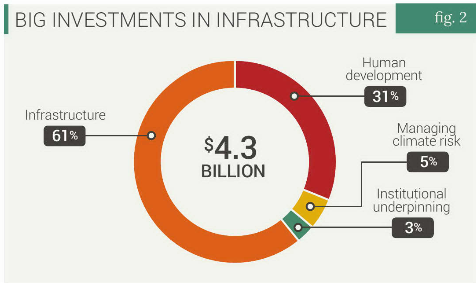 new IDA resources – the Bank’s finance at concessional rates – were committed: the largest in Kenya’s history. The value of the overall portfolio of 27 projects of about $4.3 billion as of June 2015 is almost double what it was just five years ago. Investments are spread across many key sectors, ranging from hard infrastructure (roads and energy) to human development (health and community development) to managing climate risk (agriculture and coastal management) to strengthening institutions delivering public services (judicial reform).
So the portfolio of Bank-supported projects moves forward and tackling some hurdles. But how does it contribute to the country strategy as a whole delivering results? Is it nudging Kenya closer to its aspiration of being a globally competitive and prosperous nation by 2030?
Frankly, with just one year since the country strategy (2014-2018) was approved, that question cannot be answered with a simple yes or no. But some light can be shed in following a discipline of monitoring the ‘results chain’. Take the energy sector as an example, where the first step is on track – namely the project investments, including in geothermal energy production and modernizing power lines (the principal inputs) are performing satisfactorily. Next, this should lead to milestones – specifically, commencing construction of 330km of transmission lines and substations to connect Kenya’s grid with Ethiopia.
Data shows progress. And such milestones should unlock the output of 4000 MW of generation capacity being installed and systems losses reduced to 16% by 2018. As of mid-2015, generation capacity has risen to 400 MW and the loss ratio is estimated at around 18%. Meeting these milestones and outputs will help Kenya achieve a more reliable and efficient energy supply for hosueholds (outcome).
Read the full Kenya – World Bank Group Taking Stock 2015 report.
 Netherlands for the World Bank
You must be logged in to post a comment.